Validated Benefits Advisors

Most benefits brokers are paid by the carriers they recommend. We validate advisors who serve the client, and no one else.

Hidden commissions to brokers and advisors are an ERISA violation waiting to happen — and lawsuits against employers are climbing fast. Validated Advisors and Validated Firms have been independently confirmed to take zero kickbacks, disclose every dollar, and answer only to you.

$100,000 ERISA Immunity Guarantee — Validation Institute

The "free" benefits broker isn't free.

Most employers rely on benefits firms to maximize their healthcare spend and meet their ERISA fiduciary duties. The traditional model has three big problems.

01

Hidden compensation

Traditional brokers accept undisclosed commissions, bonuses, and overrides from PBMs, carriers, and vendors — the same parties they recommend to you.

02

Conflicted advice

When a broker is paid on both sides of a transaction, you're not getting advice. You're getting a sales pitch dressed up in spreadsheets.

03

ERISA exposure

ERISA prohibits hiring benefits firms compensated on both sides for consulting and procurement. Health-plan lawsuits against employers are rising exponentially.

Why This Matters Now

ERISA class actions used to be a retirement-plan problem.

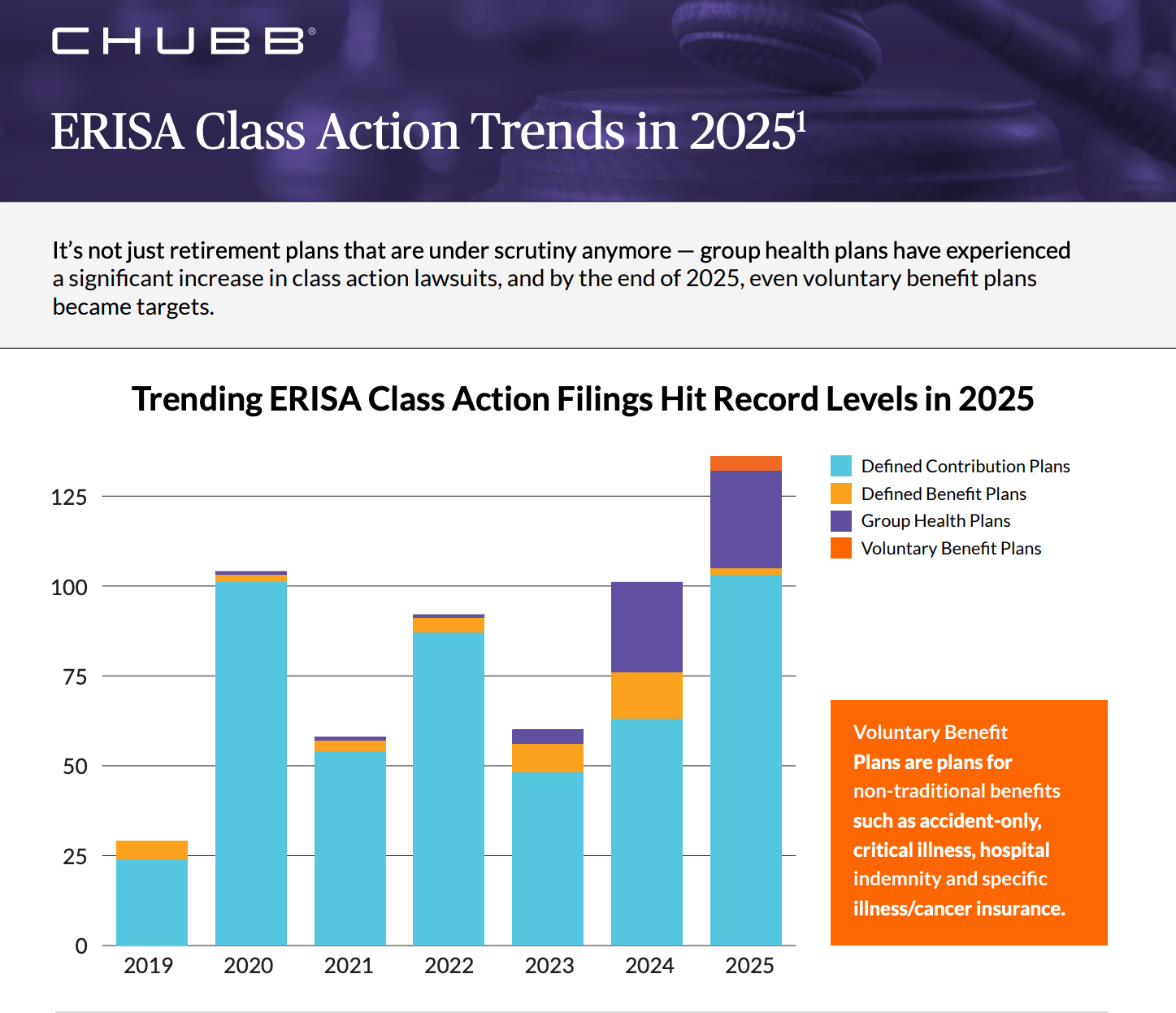
They aren't anymore. Group health plans are now squarely in the crosshairs, and 2025 set a record for total filings — with much of the new volume aimed at how plan dollars are managed across PBMs, vendors, TPAs, and advisors.

Plan sponsors are looking for partners that don't add to that risk. Advisors who can prove they manage plan assets in a manner consistent with fiduciary standards — and who have obtained real financial protection for plan sponsors to support that claim — win the business.

Chubb chart titled 'Trending ERISA Class Action Filings Hit Record Levels in 2025' showing stacked bars of Defined Contribution, Defined Benefit, Group Health, and Voluntary Benefit Plan filings from 2019 through 2025. Filings rise sharply in 2024 and again in 2025, with Group Health Plans contributing a large share of the increase.
Source: Chubb, ERISA Class Action Trends in 2025. Reproduced here as third-party industry data; not a Validation Institute publication.
What Validation Means

Fiduciary principles. No hidden conflicts.

Advisors to ERISA plans can't legally serve as plan fiduciaries — but VI-Validated firms operate by the same standards. Our validation tests one thing above all: the absence of conflicts of interest.

The work starts with the client's goals — better outcomes, lower total cost, defensible governance — and the advisor gets paid to find the best way to meet them. That's the entire incentive. There is no second loyalty pulling in another direction.

Where commissions are unavoidable (fully insured programs, voluntary benefits), they must be disclosed and never decisive.

Backed By
$100K$1M

The ERISA Immunity Guarantee

Every validated firm is backed by our ERISA Immunity Guarantee, providing employers with $100,000 to $1,000,000 of coverage. It may also reduce your own insurance premiums.

Learn about the Guarantee
The Directory

Validated advisors and firms.

Every advisor and firm below has been independently tested against our standards for full transparency and zero conflicts.

Validated

Alera Group

Brian Uhlig · Greater Chicago Office

Validated

BenefitsDNA

Justin Leader

Validated

E Powered Benefits

David Contorno

Validated

Ethos Benefits

Donovan Ryckis · Chelsea Ryckis

Validated

FoxWatch

Emma Fox

Validated

Health Compass Consulting

Donovan Pyle

Validated

Primum Risk Strategies

Terry Shook

Validated

Prosperity Benefits

Niko Caparisos

Validated

Risk Strategies

David Smith

Validated

Superior Insurance Advisors

Paul H. Flowers Jr.

Validated

The Volition Group

Matt Bittner

For Advisors

Get your firm validated.

If your firm operates without commission-driven conflicts, validation is how you prove it to employers and stand apart in a crowded market.

Objectivity Rating A

Fee-based firms appointed with all traditional carriers

  • Firm charges the employer a fee for consulting, procurement, and management services on the health plan.
  • Firm accepts no commissions, bonuses, or overrides from vendors tied to those plans.
  • Any indirect compensation from a carrier or vendor is credited 100% back to the employer.
  • All client contracts comply with disclosure rule 408(b)(2)(B).
  • Commissions from carriers for ancillary products are permitted. (Credibility Guarantee does not extend to voluntary benefits.)
Objectivity Rating B

Fee-based firms not appointed with traditional carriers

  • Firm charges the employer a fee for consulting, procurement, and management services.
  • Firm accepts no commissions, bonuses, or overrides from vendors tied to the employer's health plans.
  • All client contracts comply with disclosure rule 408(b)(2)(B).
  • Commissions from carriers for ancillary products are permitted.
The Fine Print

Qualified exceptions.

Some situations make commission removal impossible. In these narrow cases, validated firms may accept commissions — with required disclosure and conditions.

Small-group fully insured plans

Carriers set the fee or commission and it can't be stripped from premiums. If your fee exceeds the carrier's payment, credit it toward your total fee (where state law permits). If lower, accept the carrier's payment in full — rebating laws prohibit returning it.

Near-ACA-minimum employer contributions

When an employer contributes close to ACA minimums (roughly 50% of the employee-only base plan), the firm may accept commission in lieu of fees so the employer isn't carrying 100% of the cost. Must be disclosed.

MEWAs and Association Health Plans

Some large-group arrangements don't permit commission removal. Firms may accept the commission in lieu of fees; if your fee exceeds the embedded commission, credit it where state law allows, otherwise disclose.

Transition period

When taking over from an incumbent via the Broker of Record process, firms may accept compensation from existing vendors through the end of the current plan year. On renewal, all commissions must be removed from health insurance products wherever possible.

Investment

What it costs.

$5,000
One-time validation fee
  • Refund clause. $2,500 refunded if validation isn't granted based on contract language or questionnaire responses.
  • Annual renewal. $1,000 with updated templates or confirmation of unchanged language.
  • Group pricing. Custom rates for advisor groups, networks, or parent firms validating multiple offices together — book a call to scope.
  • Want $1,000,000 of coverage? The Platinum ERISA Immunity Guarantee scales the backing to $1M for independent, fiduciary-aligned firms that pass an additional rigorous review. Custom pricing applies.
Process

What to expect.

  1. Submit your materials.A signed contract you use with an existing client, proof of current appointments with major carriers, and a letter explaining any terminated appointments.
  2. Complete the validation survey.Detailed questions about your compensation structure, disclosure practices, and client governance.
  3. Respond to our feedback.We review your materials and flag any gaps. You'll have a chance to clarify or update before a decision is made.
  4. Record an interview.A recorded conversation with our team cements the validation and becomes part of your public profile.
Book your eligibility review
About validated advisors. The advisors on this list do not serve as ERISA plan fiduciaries for their clients. They help clients build the governance processes needed to discharge their own fiduciary duties — and they operate by a transparent advisory standard: full disclosure of material conflicts, no compensation structures that could reasonably influence recommendations, and solutions chosen on professional judgment of the client's needs. They do not personally accept contingent compensation, overrides, or incentives tied to placing business with particular vendors.